Are you paying your staff the correct minimum wage?

Employers must make sure their staff receive at least the National Minimum Wage or National Living Wage rate that applies to them. The correct rate depends on the worker's age and, in some cases, whether they are an apprentice.

Since 1 April 2026, workers aged 21 and over are entitled to the National Living Wage of £12.71 an hour. The rate for workers aged 18 to 20 is £10.85, while workers under 18 are entitled to minimum of £8 an hour. 

Apprentices also have a minimum rate of £8 an hour, but this does not apply throughout their apprenticeship. An apprentice is entitled to the apprentice rate if they are under 19, or if they are 19 or over and in the first year of their apprenticeship.

Once an apprentice aged 19 or over has completed the first year of their apprenticeship, they become entitled to the minimum wage rate for their age. For example, a 21-year-old apprentice in their first year is entitled to £8 an hour, but after completing that first year they must receive at least £12.71 an hour.

Employers who fail to pay the minimum wage can face significant financial penalties. HMRC can require arrears to be repaid and impose penalties of up to 200% of the underpayment, subject to the applicable rules. Serious cases can also result in criminal prosecution.

Employers should therefore review rates regularly, particularly when employees have a birthday or apprentices reach the end of their first year.

The minimum wage rates change every 1 April, so payroll systems should be updated promptly to avoid underpayments.


Source:HM Revenue & Customs| 07-09-2026

Nearly 660 employers named for minimum wage failures

The Government has named nearly 660 employers for failing to pay workers the National Minimum Wage, highlighting how costly National Minimum Wage compliance failures can become.

The latest naming round, published on 3 September 2026, involved around £4 million being repaid to more than 27,000 workers. Employers were also issued with penalties totalling £7 million.

The key point for employers is that minimum wage compliance is not simply a matter of comparing an employee's hourly rate with the statutory minimum.

For workers aged 21 and over, the National Living Wage is £12.71 an hour from April 2026. The rate is £10.85 for those aged 18 to 20 and £8.00 for workers under 18 and qualifying apprentices.

Problems can still arise where the stated hourly rate appears correct.

Employers need to consider the actual pay received for minimum wage purposes and all working time. Certain deductions can reduce minimum wage pay, while unpaid activities such as opening or closing premises, compulsory training, changing into required clothing or carrying out security checks can also create problems.

Errors may also arise where employees are expected to buy items connected with their employment.

Small mistakes repeated across several employees and over a period of time can therefore become significant liabilities.

Employers who underpay workers may have to repay arrears and face financial penalties. Public naming can also cause reputational damage.

This is a good time to carry out a simple review.

Check payroll rates, particularly after birthdays that move younger employees into a higher age band. Review deductions, working-time arrangements and any employee expenditure connected with work.

Businesses employing apprentices should also make sure the apprentice rate is being used correctly.

Most employers intend to pay staff properly. The difficulty is that the rules are more complex than they first appear.

A short review now could identify an innocent error before it becomes an expensive one.

Source:Other| 06-09-2026

How bonuses are taxed

Bonuses are treated as taxable earnings, so both employers and employees need to understand how they are taxed and reported.

For cash bonuses (including vouchers that can be exchanged for cash), the rules are straightforward. The payment is added to an employee’s normal salary and taxed through the Pay As You Earn (PAYE). This means employers must deduct Income Tax and National Insurance (Class 1) in the usual way through payroll.

Bonuses can sometimes push employees into a higher tax band for that pay period, so the net amount received may be lower than expected.

For non-cash bonuses, such as gifts or rewards, the treatment depends on what is provided. If the item is considered as something that can easily be turned into cash then it is taxed in the same way as cash through PAYE. Other benefits may instead be treated as benefits in kind. A list of typical expenses and benefits and their tax treatment can be found at https://www.gov.uk/expenses-and-benefits-a-to-z

It is important for employers to ensure they apply the correct treatment and reporting method for bonuses, as errors can lead to underpaid tax or penalties.

Source:HM Revenue & Customs| 27-04-2026

Changes to reporting of BiKs

Mandatory payrolling of benefits in kind (BiKs) and taxable employment expenses will be introduced from 6 April 2027. This represents a major change in reporting and means that for most benefits, the annual P11D form will no longer be required from the start of the 2027-28 tax year.

The requirement to report Income Tax and Class 1A National Insurance on most BiKs through Real Time Information (RTI) was originally due to start on 6 April 2026 but has been delayed until 6 April 2027 to allow additional time for employers, payroll professionals, software providers and agents to prepare.

The deadline to register for the current voluntary payrolling service for the 2026-27 tax year is 5 April 2026. After this, the service will close in preparation for the introduction of mandatory payrolling. 

From April 2027, employers will report BiKs and expenses via the Full Payment Submission (FPS), aligning reporting with the process currently used for reporting salaries. The number of RTI fields will be expanded to reflect the data currently captured through P11D and P11D(b) forms. Employers will also have the option to payroll employment-related loans and accommodation on a voluntary basis.

To support implementation, HMRC will waive penalties for inaccuracies related to mandatory payrolling for 2027–28, provided there is no evidence of deliberate non-compliance. However, existing late filing, late payment penalties and interest will continue to apply.

HMRC has confirmed that its Basic PAYE Tools software will also be updated to support payrolling of benefits in kind from April 2027.

Source:HM Revenue & Customs| 02-03-2026

Annual payroll reporting chores

There are a number of annual payroll reporting issues that employers are required to complete. With the tax year ending on 5 April 2026, this means there are several key payroll reporting chores that will need to be considered over the coming months.

One of the main requirements is submitting a final PAYE return for the tax year. The final Full Payment Submission (FPS) must be sent to HMRC on or before employees’ final payday in the 2025–26 tax year to ensure payroll records are correctly closed for the year.

Employers must also remember to provide employees with a P60 by 31 May 2026. A P60 must be issued to all employees who are on the payroll on the final day of the tax year, 5 April 2026. The P60 summarises an employee’s total pay and the tax deducted during the year and can be provided either in paper form or electronically.

Employees should be advised to keep their P60s safe, as they are an important record of tax paid and may be needed to reclaim overpaid tax, apply for tax credits, or provide evidence of income when applying for a loan or mortgage. Employees who leave during the tax year will not receive a P60, as the relevant information will already have been provided on their P45.

In addition, employers must report any Class 1A National Insurance contributions and submit P11D and P11D(b) forms to HMRC for the tax year ending 5 April 2026. The deadline for these submissions is 6 July 2026.

Source:HM Revenue & Customs| 19-01-2026

Payroll annual reporting obligations

As we move into the start of 2026, it is not that long until the current 2025–26 tax year comes to an end and there are a number of payroll annual reporting obligations that must be completed. This includes sending a final PAYE submission for the tax year. The final Full Payment Submission (FPS) needs to be submitted on or before your employees’ final payday for the 2025–26 tax year.

It is also important that employers remember to provide employees with a copy of their P60 form by 31 May 2026. A P60 must be given to all employees that are on the payroll on the last day of the tax year, 5 April 2026.

The P60 is a statement issued to employees after the end of each tax year that shows the amount of tax they have paid on their salary. Employers can provide the P60 form on paper or electronically. Employees should ensure they keep their P60s in a safe place as it is an important record of the amount of tax paid.

In addition, a P60 is required in order that an employee can prove how much tax they have paid on their salary, e.g.:

  • to claim back overpaid tax;
  • to apply for tax credits;
  • as proof of income if applying for a loan or a mortgage.

Employees who have left their employment during the tax year do not receive a P60 from their employer, as the same information will be on their P45.

The deadline for reporting any Class 1A National Insurance contributions and submitting P11D and P11D(b) forms to HMRC for the tax year ending 5 April 2026 is 6 July 2026.

Source:HM Revenue & Customs| 01-01-2026

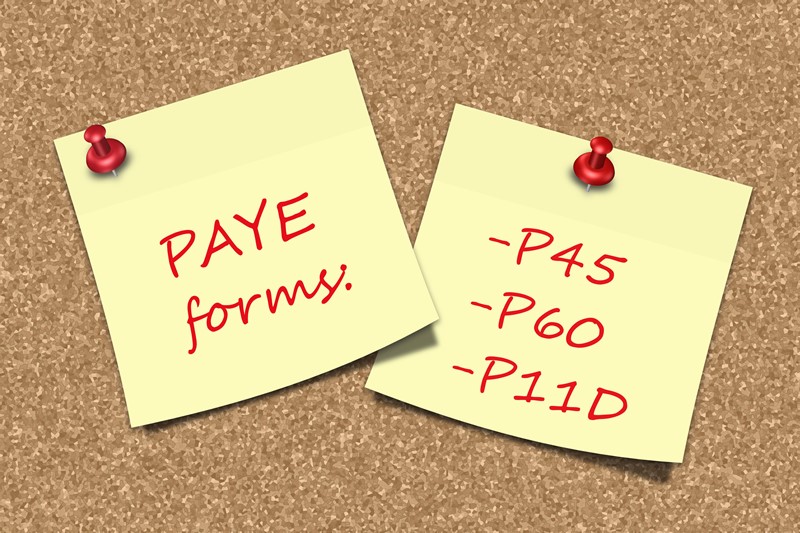
P45s, P11Ds and P60s – what are they?

Most employees will come across forms such as the P45, P11D and P60 during their working life, and knowing what each one is for can make it much easier to keep track of your tax position.

A P45 is issued to employees who leave their employment or lose their job. The P45 shows how much tax you have paid during the current tax year (6 April to 5 April). The form has four parts: your employer sends Part 1 to HMRC, gives you Part 1A for your records, and you pass Parts 2 and 3 to your new employer or Jobcentre Plus. Employers are legally required to issue a P45. If you do not have one, for example when starting your first job then your new employer will ask for details via a starter checklist to determine your correct tax code.

A P11D form is used by employers to list certain ‘benefits in kind’ provided to directors or employees. P11D forms are used to provide information to HMRC on all Benefits in Kind (BiKs), including those under the Optional Remuneration Arrangements (OpRAs) unless the employer has registered to payroll benefits. Payrolling benefits removes the requirement to complete a P11D for the selected benefits. The completed P11D form is submitted annually to HMRC. The deadline for submitting the 2025-26 form is 6 July 2026. The form can be submitted using commercial software or via HMRC’s PAYE online service.

The P60 is a statement issued to employees after the end of each tax year that shows the amount of tax they have paid on their salary. Employers can provide the P60 form on paper or electronically. Employees should ensure they keep their P60s in a safe place as it is an important record of the amount of tax paid. The deadline for employers to provide employees with a copy of their P60 form for the 2025-26 tax year is 31 May 2026. A P60 must be given to all employees that were on the payroll on the last day of the 2025-26 tax year.

Source:HM Revenue & Customs| 03-11-2025

What counts as working time for minimum wage purposes

Employers must ensure they are paying staff at least the National Minimum Wage (NMW) or National Living Wage (NLW). The NMW and the NLW are the minimum legal amounts that employers must pay their workers. The latest NMW and NLW rates took effect on 1 April 2025. The current hourly rate for the NLW is £12.21. For those aged 18 to 20, the NMW is £10.00 per hour. Workers aged 16 to 17 and apprentices are entitled to £7.55 per hour.

The minimum wage is calculated as an hourly rate, but it applies to all eligible workers however they are paid. This means that even if someone is paid an annual salary, and it is paid by the piece or in other ways, they must still calculate their equivalent hourly rate to check whether they are receiving at least the minimum wage.

To do this correctly, it is also important to understand what counts as working time under NMW rules.

According to HMRC guidance, for all types of work, this includes time spent:

  • at work and required to be working, or on standby near the workplace (but do not include rest breaks that are taken);
  • not working because of machine breakdown, but kept at the workplace;
  • waiting to collect goods, meet someone for work or start a job;
  • travelling in connection with work, including travelling from one work assignment to another;
  • training or travelling to training;
  • at work and under certain work-related responsibilities even when workers are allowed to sleep (whether or not a place to sleep is provided).

Working time does not include time spent:

  • travelling between home and work;
  • away from work on rest breaks, holidays, sick leave or maternity leave;
  • on industrial action; and
  • not working but at the workplace or available for work at or near the workplace during a time when workers are allowed to sleep (and you provide a place to sleep).
Source:HM Revenue & Customs| 01-09-2025

Fixing problems with running payroll

Employers must report pay and deductions correctly to HMRC, but errors can usually be fixed in your next FPS.

Employers need to use payroll software or other payroll services to record employees pay, deductions and national insurance contributions on or before each payday. They also need to consider other deductions such as pension contributions and student loan payments.

These payments are reported to HMRC in real time using a Full Payment Submission (FPS). This submission contains all relevant information for each employee.

If you have made a mistake with an employee’s pay or deductions this can usually be corrected by updating the year-to-date figures in your next regular FPS.

HMRC’s guidance also states that you can correct mistakes by submitting an additional FPS before your next regular FPS is due. You would need to:

  • update the ‘this pay period’ figures with the difference between what you originally reported and the correct figures
  • correct the year-to-date figures
  • put the same payment date as the original FPS
  • put the same pay frequency as the original FPS
  • put ‘H – Correction to earlier submission’ in the ‘Late reporting reason’ field

If you need to correct an employee’s National Insurance deductions, the action required will depend on whether the mistake occurred in this tax year or earlier tax years. There are also different actions that may be required to fix a mistake with an employee’s student loan repayments, again depending what tax year the mistake relates to.

Source:HM Revenue & Customs| 25-08-2025

Setting up a payroll scheme

Registering for payroll is essential when hiring staff. From HMRC registration to legal compliance, getting payroll processes right ensures your team is paid correctly and your business avoids penalties.

When starting a business and hiring employees for the first time, one of the most important administrative steps is setting up a payroll scheme. This process ensures your employees are paid correctly and that your business complies with the necessary tax and employment laws.

The first step is to register as an employer with HMRC. You must register even if you are only employing yourself, for example you are the director of a limited company. This registration must be completed before your first payday. You need to register in most scenarios including for any employee earning at or over the minimum secondary threshold of £96 a week (2025–26 threshold).

Another important part of the payroll process is deciding whether you will run payroll yourself or use a payroll provider. If you manage it yourself, you must choose an approved HMRC-recognised payroll software to record employee details, calculate pay and deductions and report to HMRC.

Once registered, you’ll need to:

  • Collect and maintain employee records.
  • Report employee information to HMRC.
  • Make accurate tax and National Insurance deductions.
  • Submit reports to HMRC using Real Time Information (RTI) on or before each payday.
  • Pay HMRC what you owe in tax and National Insurance.

You must also:

  • Comply with National Minimum Wage laws.
  • Check employees’ legal right to work in the UK.
  • Set up a workplace pension scheme for eligible staff.

You will also need to complete annual payroll tasks. Setting up a payroll scheme can be complex, and we would of course be happy to help you choose the optimal set-up for your circumstances. We can also, if required, manage the payroll process for you.

Source:HM Revenue & Customs| 30-06-2025

Reversal of requirement to report more detailed employee hours paid

The government has scrapped plans for detailed PAYE reporting of employee hours from April 2026, citing concerns over cost, complexity, and practicality. Employers will stick with current rules.

As part of the Spring 2025 Tax Update: Simplification, Administration and Reform summary, the government confirmed that it will no longer proceed with the previous governments plans to mandate more detailed reporting of employee working hours through Pay As You Earn (PAYE) Real Time Information (RTI) submissions. 

Under the original proposals, employers would have been required to submit significantly more detailed employee hours data on the hours worked by each employee via RTI returns from 6 April 2026. These proposals were reflected in the draft Income Tax (Pay As You Earn) (Amendment) Regulations 2025, which were expected to formalise the changes in law. However, the government has now announced that it will not take these draft regulations forward, effectively shelving the proposed reforms.

The enhanced reporting requirements would have meant employers providing detailed data on actual hours worked per pay period, as opposed to the current obligation to report an employee’s normal working hours. Significant concerns were raised by employers, payroll providers, and representative bodies regarding the complexity, cost, and practicality of these changes. 

Employers will therefore continue to report normal hours worked using the existing RTI framework, without the need to supply more detailed information. 
 

Source:HM Government| 05-05-2025

Mandating the Payrolling of benefits in kind update

HMRC has delayed mandatory payrolling of benefits in kind by a year to April 2027, giving employers and software providers more time to prepare. Penalties will be eased in the first year.

The requirement to report Income Tax and Class 1A National Insurance Contributions for most BiKs and expenses through Real Time Information (RTI) will now begin from 6 April 2027, rather than 6 April 2026 as previously announced.

From April 2027, employers will report BiKs and expenses via the Full Payment Submission (FPS), aligning with the method currently used for reporting salaries. The number of RTI fields will be expanded to reflect the data currently captured through P11D and P11D(b) forms.

The deferral is intended to give payroll professionals, software providers, tax agents and others additional time to prepare for the transition. From April 2027, employers will also have the option to payroll employment-related loans and accommodation on a voluntary basis.

To support a smooth rollout, HMRC will waive penalties for inaccuracies related to mandatory payrolling for 2027–28, provided there is no evidence of deliberate non-compliance. However, existing late filing, late payment penalties, and interest will continue to apply.

HMRC has confirmed that its Basic PAYE Tools software will also be updated to support payrolling of benefits in kind from April 2027.

Source:HM Revenue & Customs| 05-05-2025

Autumn Budget 2024 – Minimum Wage increases

The Chancellor of the Exchequer, Rachel Reeves announced significant increases to the Minimum Wage rates on the eve of the Budget. The Chancellor confirmed that the government has accepted in full the proposals of the Low Pay Commission (LPC) for increasing minimum wage rates from 1 April 2025. The LPC’s advisory remit was overhauled by ministers in July to consider the cost of living.

The National Living Wage (NLW) rate will increase from £11.44 to £12.21 on 1 April 2025 and represents an increase of 77p or 6.7%. The NLW is the minimum hourly rate that must be paid to those aged 21 or over. The increase represents a pay rise of over £1,400 a year for someone working full-time and earning the NLW.

It was also announced that the National Minimum Wage (for 18-20 year olds) will increase from £8.60 to £10.00 an hour. This is largest increase ever in the NMW (an impressive 16.3% increase) that will see younger workers having their pay boosted by up to £2,500 next year. This increase is part of a move to narrow the gap in wage rates for 18-20 years olds and the NLW and ultimately create a single adult wage rate for all those aged 18 and over.

The NMW rates for 16 to 17 years old will increase from £6.40 to £7.55 – an increase of £1.15 or 18% per hour – from next April. The Apprentice Rate will mirror this increase in line with earlier recommendations by the LPC.

Source:HM Treasury| 30-10-2024

Starter checklist for PAYE

When hiring a new employee, employers must determine the appropriate tax code and starter declaration for their payroll software. Using incorrect tax codes can result in the new employee over or underpaying their taxes. To ensure the correct information is entered, employers need certain details from the new employee, most of which are usually provided on the employee's P45. It's important to remind new employees to bring their P45 on their first day.

If the employee does not have a P45, the required information can be gathered by asking them to complete HMRC’s online PAYE starter checklist. If they cannot use the online version, a paper version is also available. Employers must keep this information in their payroll records for the current tax year and the following three tax years. Once the information is collected, employers can use HMRC’s online tool to determine the employee’s tax code.

The starter checklist should be completed by new employees in the following cases:

  • They have a student or postgraduate loan
  • Their personal details differ from those on their P45
  • They do not have a P45
  • They have been sent to work temporarily in the UK by their overseas employer

Once the checklist is completed, the employee can submit it to their employer via email, post, or in person. There is no need to send the checklist to HMRC.

Source:HM Revenue & Customs| 30-09-2024

Employing under 16-year-olds and young workers

When a new employee is added to the payroll it is the employers' responsibility to ensure they meet the employees’ rights and deduct the correct amount of tax from their salary. This includes any employees who are family members.

It is possible to employ young people if they are 13 or over but there are special rules regarding how long they can work and what jobs they can undertake. Children younger than 13 can work in certain areas such as television, theatre and modelling but their employer will need to apply for a child performance licence. There is no National Insurance liability for children under 16 and they would only need to be included on an employer’s payroll if their total income is over their Personal Allowance.

Young workers (aged 16 to 17) are subject to different National Minimum Wage rates. The current minimum hourly rate for this age group is £6.40. Any payments to young workers need to be handled through the payroll. If the workers earn more than £123 a week, then the employer will also need to do undertake regular PAYE tasks like making deductions.

There are different rules if you take on volunteers or voluntary staff, but the employer is still responsible for health and safety and must give inductions and training in the tasks they are going to do.

Source:HM Revenue & Customs| 02-09-2024